New Chinese dam: India and Bangladesh are worried
Updated: Jan 10
Noémie Valéry
Source image : Le Monde
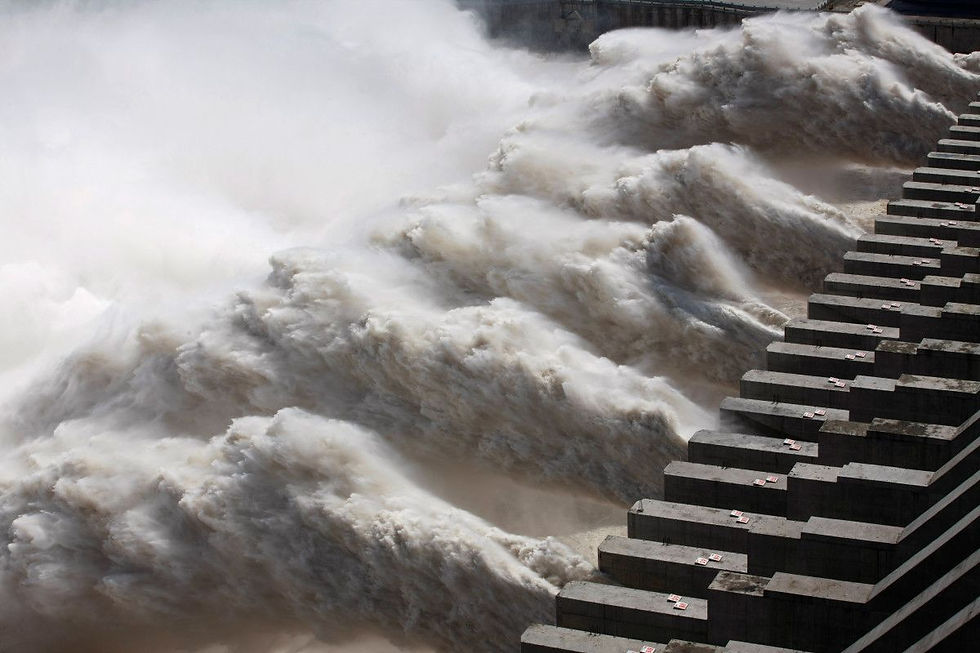
On 19 July 2025, Chinese Prime Minister Li Qiang attended the official ceremony marking the start of construction of the Yarlung Zangbo hydropower project. This project, whose main structure is the Medog (or Motuo) hydropower station, involves the construction of five hydroelectric facilities along the Yarlung Tsangpo River in Southwestern China’s Tibet Autonomous Region. This megastructure, with an expected installed capacity of around 60 GW, would be three times more powerful than the Three Gorges Dam. Such capacity is equivalent to the entire French nuclear power fleet, and the project’s cost is estimated at 165 billion US dollars in investment.
This colossal project fits within China’s broader decarbonization strategy. As the world leader in renewable energy development, Xi Jinping pledged in 2020 that China would achieve carbon neutrality by 2060. Expanding hydropower is therefore logically one of the country’s priorities. China already operates the world’s largest dam, the Three Gorges Dam, and manages a hydropower network of more than 94,000 dams in total, according to the Chinese National Energy Administration. Beyond meeting China’s growing energy needs and reducing dependence on coal, the Motuo Dam is also intended to stimulate industrial and economic development in a region that remains difficult to access and relatively isolated from the rest of the country.
However, the project lies at the center of significant geopolitical and environmental controversies. First, the Yarlung Tsangpo River originates in the Himalayas and flows through India and Bangladesh, where it is known as the Brahmaputra River. The construction of the Motuo Dam represents a potential additional means for China to exert control over this vital water source. What is particularly concerning is that China is not a signatory to the 1997 UN Convention on the Law of the Non-Navigational Uses of International Watercourses. This absence increases the risk that China could exploit this hydrological asymmetry, or even use it as a political pressure tool through episodes of droughts or floods. In response to the project’s approval, Indian Minister of State for External Affairs Kirti Vardhan Singh stated that India “carefully monitors all developments relating to the Brahmaputra River, including plans by China to develop hydropower projects, and takes necessary measures to protect our interests, including preventive and corrective measures to safeguard the life and livelihood of Indian citizens residing in downstream areas.”
These concerns are also rooted in a context of structural tensions, notably border disputes between China and India, particularly over Arunachal Pradesh, as well as Bangladesh’s dependence on both China and India due to its position far downstream along the river. It is important to note that, unlike the Three Gorges Dam, the Motuo Dam is designed as a run-of-river facility, without a large reservoir. Taken alone, it does not allow China to store water or exert long-term control over the Brahmaputra’s seasonal flows. However, when combined with existing dams such as Zangmu, Dagu, Jiexu or Jiacha, and planned cascade projects on the Yarlung Tsangpo, it grants China a short-term capacity to regulate river flows, particularly during flood periods, which is an ongoing source of concern for downstream countries.
This large-scale project has also sparked significant environmental concerns. The Medog region is renowned for its rich biodiversity, which the dam threatens to severely disrupt. Moreover, the project’s geography exposes it to major technical and natural risks: high seismic activity, extreme altitude, landslides, and heavy rainfall all pose serious challenges. According to the United States Geological Survey, 15% of the world’s 20th-century earthquakes occurred in this region, raising questions about the dam’s resilience and long-term durability. In addition, the dam’s construction could result in the uprooting of thousands of Tibetans and the destruction of monasteries, according to the NGO International Campaign for Tibet. Many people depend directly on the Brahmaputra River for agriculture, drinking water, and electricity generation, underscoring the profound human challenge posed by this project.
Sources
The state council of the People’s Republic of China : Chinese premier announces construction of Yarlung Zangbo hydropower project https://english.www.gov.cn/news/202507/19/content_WS687b6a8ac6d0868f4e8f4486.html
Conflits, revue de géopolitique : Un barrage peut en cacher un autre : le projet chinois de Metog
European Union External Action, The Diplomatic Service of the European Union : China carbon neutrality in 2060: a possible game changer for climate
Sustainability Times : “This Will Destroy Everything”: China’s Secret $165 Billion Tibetan Dam Project Sparks International Water War
The Daily Star : Tibet dam plan: India conveys concerns to China
UN Treaty Collection : Convention on the Law of the Non-Navigational Uses of International Watercourses
The Times of India : “Water Bomb”: China building world’s most powerful mega dam in the Himalayas - how it impacts India
International Campaign for Tibet : Chinese hydropower, damning tibet’s culture, community, and environment


Comments